|
Country-Specific Infrastructure
Find the Internet pathways
in/out of a country via exchange points, ISPs, and telecom carriers.
|
 |
Exchange points:
-
List of
exchange points from Wikipedia,
list
of exchange points listed by traffic
-
Peering database - THE database of
600 public exchange points, and 7400 peering networks
-
Old pages from EP.net = Europe ,
Asia/Pacific ,
North America ,
Latin America ,
Africa/MidEast
-
Euro IX's List of
Exchange Points from around the world,
partial list sorted by number of ISP's,
a video about Internet
+ exchange points,
-
Telegeography list of exchange points
-
drpeering.net - great insights into
Internet Peering.
-
Global Peering Forum .
-
Example links: Hong Kong (
ISP list,
telcos), Thailand (internet
map, connectivity,
Wilshire) SAIX-South
Africa, Greece peering matrix,
Slovak Peering,
Argentina wall,
Argentina router, Romania traffic,
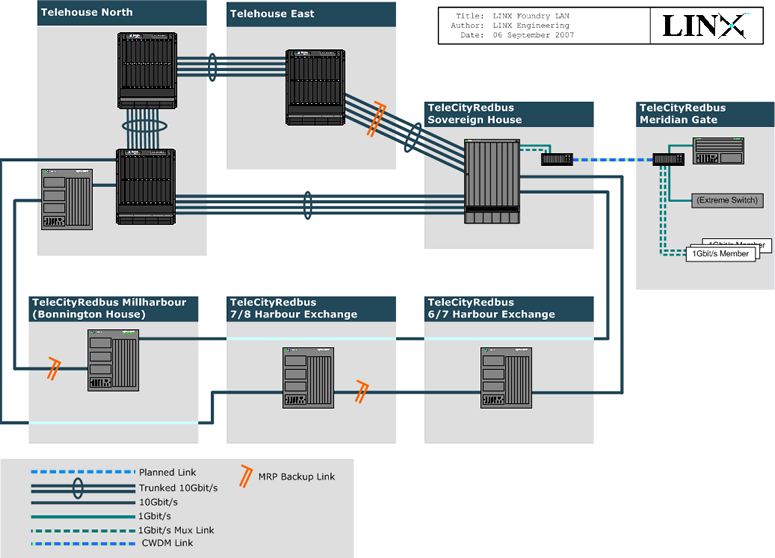
Sweden Traffic, London Architecture,
Colombia
statistics,
Nap of the Americas in Miami,
Underwater cables and example network maps
-
List of cables
at Wikipedia,
- Submarine Cable Map from
Telegeography, Greg's cable map.
- Alcatel maps: world
map, Mediterranean,
Caribbean ,Asian
,north Europe,
- Submarine Telecom
forum. Tons of information about underwater cables,
Huge almanac,
list of previous monthly journals, example issue
42)
- Video animations:
Laying the cables ,
repairing cables
- International cable protection
committee.
- NSW a cable company
-
Some pictures of cables.
-
detailed narration of a cable project (long but lots of insight)
-
Cable Cut Presentation - shows all the cable cuts from a major earthquake
near Taiwan
-
Alcatel-lucent - submarine network solutions (map,
and brochure)
- Example backbones: Russ Haynal's ISP page,
Reach Backbone map, TAE network, Tata
communications,
- NSRC - has
historical information about countries initially getting connected
Satellite :
Lyngsat, SatNews,
uplinkstation,
Datacenters / Web hosting / Cloud services
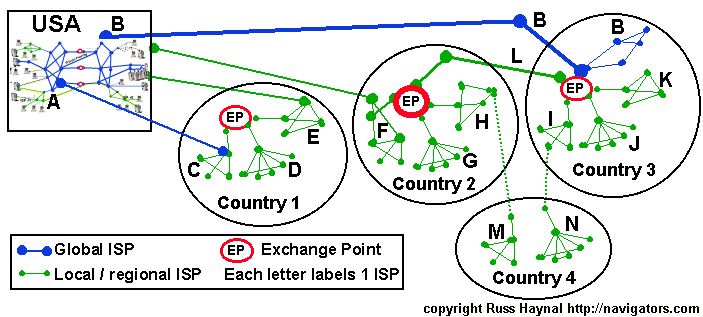
Countries develop local ISPs and local exchange points. However not all
ISPs will connect to the EP. Even if they are connected to an EP, there is
no guarantee as to which ISPs will "peer" with their neighbors at the same EP.
Some scenarios:
-
Country 1 - ISPs C,D each have Internet connections to US providers who
inter-connect with each other. IF C and D do not agree to peer at their
country EP, then traffic between these two ISPs will flow via the US providers.
C and D eventually become financially motivated to connect with each other in
order to keep local traffic "local" and thus reduce the amount of international
traffic they may be paying for. ISP D must enter into an agreement
with either C or E if his traffic is to leave the country. Country 1 can
only be reached via US connections.
-
Country 2 - has an EP that has attracted the interest of a regional provider "L"
How does traffic from G reach J? It depends on the peering agreements in placed
at both countries. It could be a short hop via L or it may have to travel
via US on G->B->J
-
Country 3 - Their exchange point has attracted at least one major international
ISP (UUNET, Teleglobe, Cable & Wireless, etc)
To learn about a country's infrastructure - begin with their Internet
Exchange points. There may be an
exchange point within the country where many local ISPs interconnect with each
other. Some Exchange points may be global in nature, where
many international carriers and some larger regional carriers can interconnect.
- go to the exchange point's home page - it might list who is connected.
These ISPs should be the country's "larger" ISPs since they are
present at an exchange point. In most of these exchange point lists you
will see the significant ISPs from within a country and then a couple of the
larger regional or international ISPs (Verizon, C&W, AT&T, Teleglobe,
Sprint) Some exchange points will also mention a list of
telecommunications carrier that service their facility. ISPs would lease a
circuit from one of these carriers in order to connect to the exchange point.
Ultimately, the most definitive picture of the
Internet infrastructure into/out of a country comes from doing traceroutes.
You must first identify destination sites which are "definitely" hosted
physically inside the country (A traceroute will help confirm this) Easy
hosts to trace towards, would include ISP homepages, Exchange Points, traceroute
servers, Government homepages, etc. since these would tend to be located
within their own country. Due to routing asymmetry, you should also
trace FROM the country outward -Use the resources on my traceroute
page to locate traceroute servers from around the world.

Contact me at 703-729-1757 or Russ
'at' navigators.com
If you use email, put "internet training" in the subject of the
email.
Copyright © Information Navigators